
Somewhere between 460,000 and 500,000 Nigerian-born individuals currently call the United States home, with the broader Nigerian-American community reaching closer to 850,000 once second and third generations join the count, according to the US Census Bureau’s American Community Survey. That massive community still runs into the same recurring wall: a Nigeria court affidavit that a bank, an embassy, or a property transaction back home suddenly requires, with no clear path to obtaining one from a US zip code. A Nigerian court affidavit for Nigerians living thousands of miles from the nearest Commissioner for Oaths often means either an expensive, disruptive flight home or months of confused back-and-forth with relatives trying to navigate an unfamiliar court process on someone else’s behalf. Picture a Nigerian engineer in Houston discovering, mid-way through closing on a family property in Lagos, that the transaction cannot proceed without a sworn affidavit only a Nigerian court can issue.
Anyone facing this exact obstacle keeps asking the same pressing questions:
- Can Nigerians in the US actually obtain a Nigeria court affidavit without flying home?
- Which Nigerian courts or platforms support remote swearing from abroad?
- What situations, from name changes to lost documents, actually require a Nigeria court affidavit?
- How does the process work once the document gets sworn and sealed?
- What happens if a US notary tries to substitute for a genuine Nigeria court affidavit?
Piecing together scattered advice from community forums rarely resolves these questions with confidence. This guide breaks down exactly how Nigerians in the US can secure a Nigeria court affidavit, step by step, without the stress of an unplanned trip home. DocuTrust Africa takes it further, coordinating the entire court process on behalf of clients, so Nigerians across America get a valid Nigeria court affidavit without ever leaving their city.
Get Your Affidavit Processed Quickly and Professionally
Obtain sworn affidavits for name changes, loss of documents, correction of information, age declaration, and other legal declarations with expert assistance.
Request an AffidavitWhat Is a Nigeria Court Affidavit?
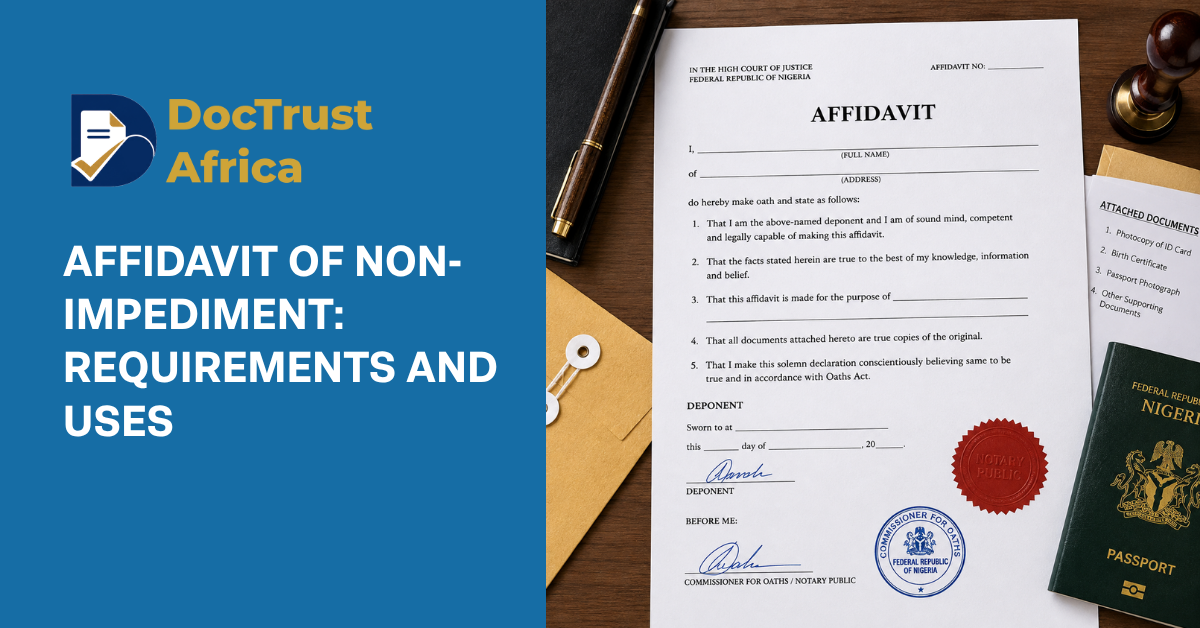
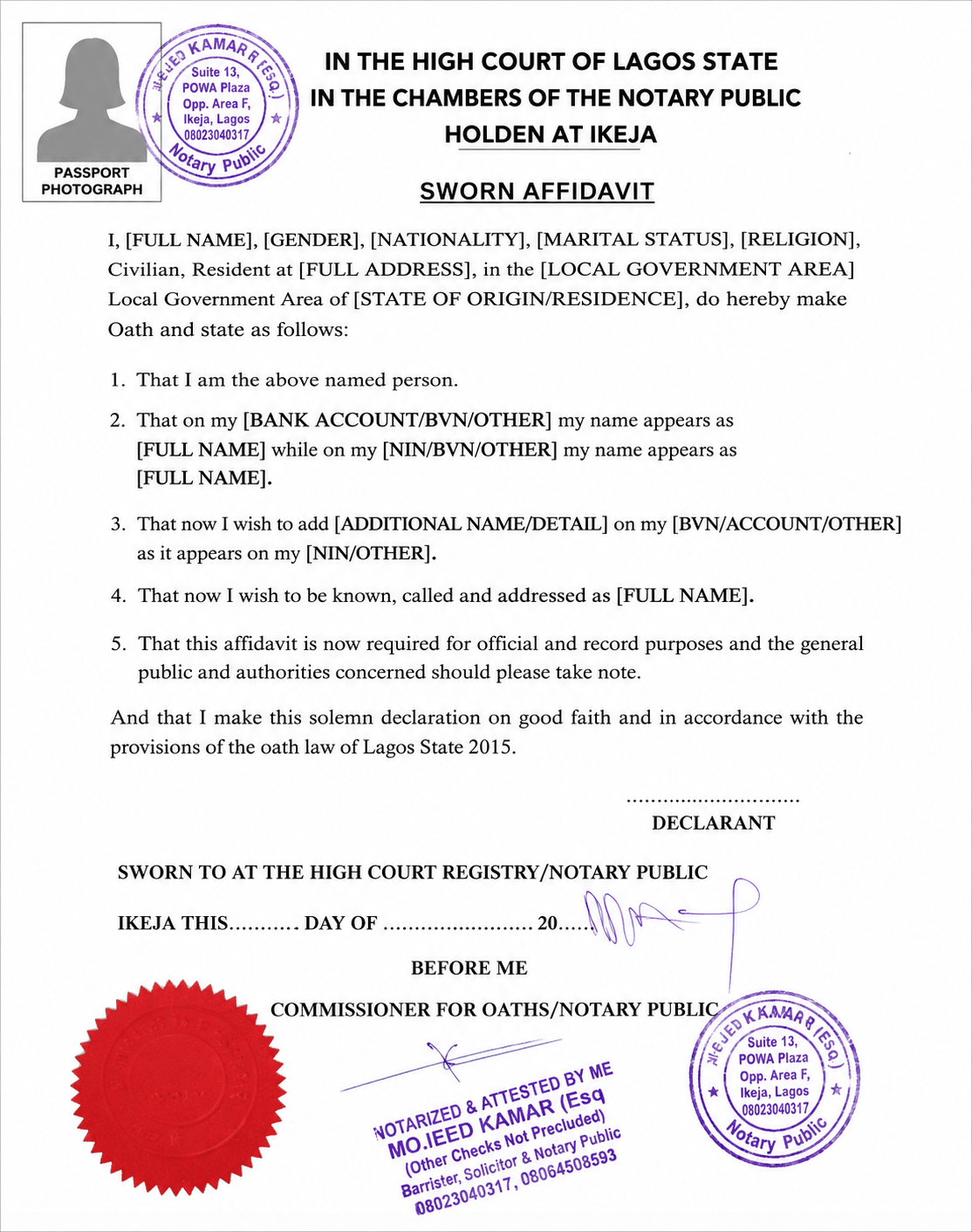
A Nigeria court affidavit stands as a sworn written statement, made under oath before an authorized official, declaring a specific fact or set of facts as true. Nigerian institutions treat this document as legally binding evidence, since Nigerian courts recognize a properly sworn affidavit as equivalent to testimony given directly in a courtroom.
Applicants use a Nigeria court affidavit for a wide range of purposes: correcting a name, declaring a lost document, confirming an age, supporting a power of attorney, or backing up a business or property transaction. Understanding this broad utility matters, since a Nigeria court affidavit for Nigerians living abroad often becomes the single missing piece blocking an otherwise straightforward transaction back home.
The Legal Basis: Oaths Act and Evidence Act
Every Nigeria court affidavit derives its authority from the Oaths Act, Laws of the Federation of Nigeria (LFN) 2004, alongside the Oaths (Amendment) Act 2016, which introduced further procedural updates. This law authorizes specific officials to witness and validate a sworn declaration, including:
- A Commissioner for Oaths at a High Court or Magistrate Court
- A Notary Public
- Judges of the Federal High Court, Court of Appeal, and Supreme Court, in specific circumstances
The Evidence Act 2011 treats affidavit content as sworn testimony, meaning a Nigeria court affidavit carries the same legal weight as testimony given in open court. Providing false information exposes a deponent to criminal liability, which explains why Nigerian institutions treat a properly sworn Nigeria court affidavit as reliable, court-backed evidence.
Why Nigerians in the US Still Need a Nigeria Court Affidavit
American notarization and Nigerian court affidavits serve different legal systems entirely, and this distinction trips up many Nigerians living abroad. A US notary public confirms identity and witnesses a signature under American law, but Nigerian institutions, including banks, courts, and government agencies, typically require a document sworn specifically under the Nigerian Oaths Act.
This means a Nigeria court affidavit for Nigerians in Houston, New York, or Atlanta still needs to go through a process recognized by Nigerian law, even while the applicant remains physically in the United States. Understanding this gap early prevents the common frustration of submitting a US-notarized document to a Nigerian institution, only to have it rejected outright.
Common Situations That Require a Nigeria Court Affidavit for Nigerians Abroad
Several recurring situations push Nigerians in the US toward needing a Nigeria court affidavit:
- Property transactions back home, where a family member requires a sworn declaration to complete a sale or transfer
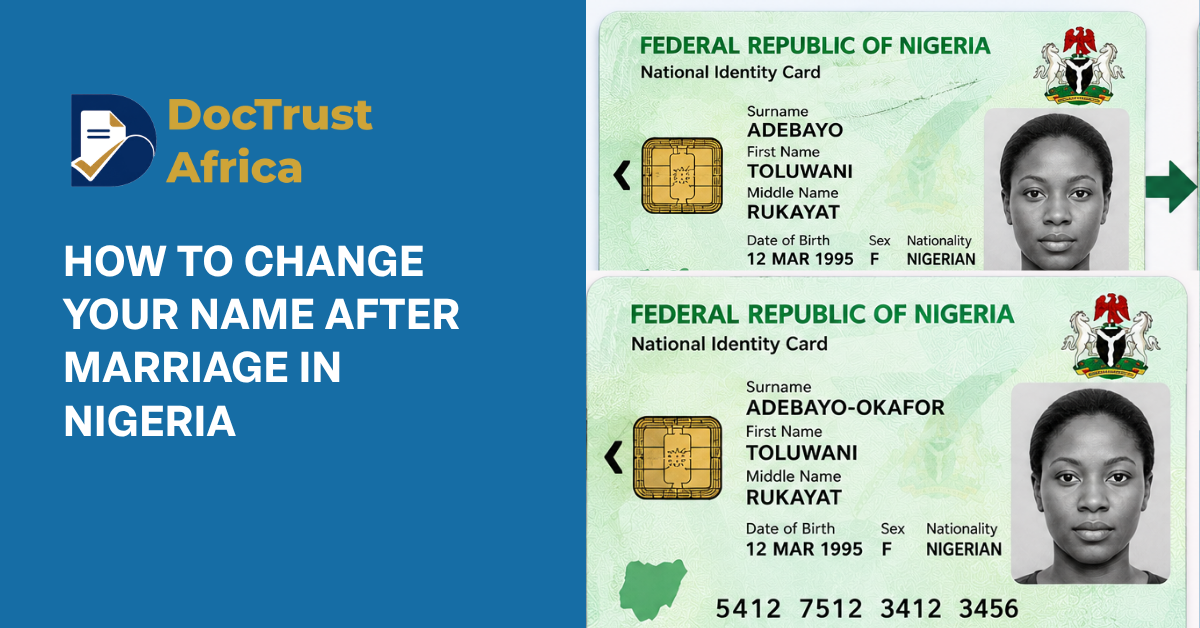
- Change of name, particularly after marriage, divorce, or a spelling correction on official records
- Power of attorney, authorizing a trusted representative in Nigeria to act on the applicant’s behalf
- Lost document declarations, covering a missing birth certificate, WAEC certificate, or NYSC discharge certificate
- Age declaration, where no original birth certificate exists to confirm date of birth
- Business and CAC matters, including business name registration or company incorporation requiring a sworn declaration
Each of these situations relies on a properly sworn Nigeria court affidavit, since Nigerian institutions generally will not accept a substitute document sworn under a foreign legal system.
Can a US Notary Replace a Nigeria Court Affidavit?
This question comes up constantly among Nigerians in the diaspora, and the short answer stays consistent: no, in most cases. A US notary public operates entirely within American law, confirming identity and witnessing signatures for documents intended for use within the United States or in countries that recognize US notarization under specific treaties.
A Nigeria court affidavit, by contrast, requires swearing before a Commissioner for Oaths under the Oaths Act 2004, a distinctly Nigerian legal process. Nigerian banks, courts, and government agencies generally expect this specific format, which means Nigerians in the US cannot simply substitute a local notarized document for a genuine Nigeria court affidavit without risking outright rejection.
How to Obtain a Nigeria Court Affidavit From the United States
Nigerian courts have modernized significantly, and applicants no longer need to fly home for every sworn declaration. Several Nigerian states now operate an e-Affidavit platform, allowing a Commissioner for Oaths to verify identity and witness a signature remotely through video verification.
Follow this sequence to obtain a Nigeria court affidavit for Nigerians living in the US remotely:
- Identify a supported court or platform. Confirm which Nigerian court or e-Affidavit platform accepts remote applications from abroad.
- Gather your documents. Prepare scanned, high-resolution copies of your identification and any supporting evidence relevant to your specific affidavit type.
- Complete the online application. Submit your details through the platform, including the exact wording your affidavit needs to declare.
- Complete identity verification. Most platforms use video verification to confirm the applicant’s identity before proceeding.
- Swear the declaration remotely. The Commissioner for Oaths witnesses the swearing process virtually, confirming the applicant’s understanding and agreement.
- Receive your signed and sealed document. The completed Nigeria court affidavit arrives electronically, often within 24 hours.
This remote process gives Nigerians across the US a realistic path to obtaining a Nigeria court affidavit without booking a flight home. For individuals seeking a smooth and reliable process, DocuTrust Africa provides end-to-end support, helping clients without the confusion, delays, and administrative challenges often associated with document processing.
Documents Required for a Nigeria Court Affidavit
Gathering the right documents in advance speeds up the process considerably, whether applying remotely or through a representative in Nigeria. Typical requirements include:
| Requirement | Purpose |
| Valid means of identification | Confirms the applicant’s identity |
| Passport photograph | Attached to the sworn document |
| Supporting evidence specific to the affidavit type | Backs up the exact declaration being made |
| Contact details | Needed for correspondence during the verification process |
| Nigerian address, where applicable | Some affidavits reference a specific Nigerian location or transaction |
Applicants pursuing a Nigeria court affidavit for Nigerians abroad should confirm the specific document requirements with the chosen court or platform, since requirements can vary slightly depending on the affidavit’s purpose.
Get Your Affidavit Processed Quickly and Professionally
Obtain sworn affidavits for name changes, loss of documents, correction of information, age declaration, and other legal declarations with expert assistance.
Request an AffidavitTraditional Route: Power of Attorney and In-Person Swearing
Some situations still call for the traditional route, particularly when a Nigerian institution insists on original, physically signed documentation. In these cases, applicants have two realistic options:
- Grant a Power of Attorney to a trusted representative in Nigeria, allowing that person to handle the affidavit process, along with related paperwork, on the applicant’s behalf.
- Coordinate with a Nigerian embassy or consulate in the US, some of which offer limited notarial or affidavit-adjacent services, though these vary significantly by mission and specific document type.
Choosing between the remote e-Affidavit route and the traditional Power of Attorney route depends heavily on the specific institution requesting the Nigeria court affidavit, so confirming this detail early saves considerable back-and-forth later.
Cost of Obtaining a Nigeria Court Affidavit for Nigerians in the US
Costs vary depending on the affidavit type, the platform or court used, and whether additional services like Power of Attorney drafting apply. A general breakdown includes:
- Standard court affidavit fee: ₦5,000 to ₦15,000, depending on the type and issuing court
- e-Affidavit platform processing: Additional service fee, varying by platform
- Power of Attorney drafting, if needed: Varies based on complexity and legal support required
- Follow-up newspaper publication, where applicable: ₦10,00 to ₦25,000, depending on the newspaper chosen
Budgeting for these combined costs gives applicants a realistic financial picture before starting the process of obtaining a Nigeria court affidavit for Nigerians in the US.
How Long Does the Process Take?
Timelines depend heavily on the chosen route and how quickly supporting documents come together. Under normal conditions:
- Remote e-Affidavit swearing: Often completed within 24 hours of identity verification
- Traditional Power of Attorney route: A few days to a couple of weeks, depending on drafting and coordination with a Nigerian representative
- Follow-up steps, such as newspaper publication: 1 to 3 days online, or longer through traditional submission
Applicants who prepare accurate, complete documentation from the start generally move through the process of obtaining a Nigeria court affidavit for Nigerians in the US faster than those who submit incomplete information requiring correction.
What Happens After You Get Your Nigeria Court Affidavit
Obtaining the sworn document often marks only the first step in a broader process. Depending on the specific situation, applicants may still need to:
- Submit the affidavit to the relevant Nigerian institution. Banks, the National Identity Management Commission (NIMC), the Nigeria Immigration Service, or the Corporate Affairs Commission (CAC) may each require the document for different purposes.
- Complete newspaper publication, where required. Certain affidavit types, particularly name changes, need a public notice alongside the sworn declaration.
- Coordinate with a representative in Nigeria. Physical submission or in-person follow-up sometimes remains necessary, even after obtaining the affidavit remotely.
- Keep multiple certified copies. Different institutions may request originals or certified true copies at different stages of a transaction.
Treating the Nigeria court affidavit as one piece within a larger process, rather than the final step, prevents applicants from assuming the sworn document alone resolves every requirement.
Verifying a Legitimate Nigeria Court Affidavit
Fraudulent platforms occasionally target Nigerians abroad, promising a fast Nigeria court affidavit for a fee, only to deliver a document with no real legal standing. Protecting against this risk matters as much as understanding the underlying process itself. A genuine Nigeria court affidavit for Nigerians living in the US should carry:
- An official stamp and seal from a recognized Commissioner for Oaths
- A verifiable court reference number tied to a specific Nigerian court registry
- Consistent formatting matching that specific court’s standard affidavit template
- A traceable record that the issuing court or platform can confirm upon request
Applicants who feel uncertain about a specific e-Affidavit platform’s legitimacy should confirm directly with the referenced Nigerian court, or work with an established service provider familiar with verified platforms, rather than risk submitting a document that later gets flagged as invalid at a Nigerian bank, embassy, or government office.
Comparing the Remote and Traditional Routes
Choosing between the remote e-Affidavit process and the traditional Power of Attorney route depends on several practical factors specific to each applicant’s situation.
| Factor | Remote e-Affidavit | Traditional Power of Attorney |
| Travel required | None | None, but requires a trusted representative in Nigeria |
| Processing speed | Often within 24 hours | A few days to a couple of weeks |
| Best suited for | Straightforward sworn declarations | Complex transactions needing physical signatures or representation |
| Institutional acceptance | Growing, though not universal across every Nigerian institution | Long-established and widely accepted |
Weighing these factors against the specific institution requesting the Nigeria court affidavit for Nigerians in the US gives applicants a clearer sense of which route fits their exact situation best.
- Assuming a US notary substitutes for a Nigeria court affidavit. Nigerian institutions generally reject foreign-notarized documents in place of one sworn under the Oaths Act.
- Choosing an unverified online platform. Confirm any e-Affidavit service operates under legitimate Nigerian court authority before submitting sensitive documents.
- Providing inconsistent details across documents. Any mismatch between the affidavit and supporting identification can trigger rejection at the receiving institution.
- Skipping follow-up steps. Some affidavit types, particularly name changes, require newspaper publication before an institution considers the process complete.
- Waiting until an urgent deadline. Property transactions, business registrations, and other time-sensitive matters rarely pause for a delayed affidavit, so starting early avoids unnecessary pressure.
Why Choose DocuTrust Africa For This Process
Understanding how a Nigeria court affidavit for Nigerians in the US works is one thing; coordinating the right platform, the correct documentation, and any required follow-up without delay is another challenge entirely. DocuTrust Africa handles affidavit services for name correction, age declaration, loss of documents, and other sworn declarations, alongside newspaper publication and CAC business registration support.
Whether a client lives in Houston, New York, Atlanta, or anywhere else across the US, DocuTrust Africa’s five-step process consultation, requirement review, document submission, processing support, and confirmation removes the guesswork from obtaining a Nigeria court affidavit remotely. The team coordinates directly with Nigerian courts and platforms on the client’s behalf, so Nigerians in America never need to navigate an unfamiliar legal system alone. Reach the team at support@docutrustafrica.com or +234 704 029 4819, or start an application through the DocuTrust Africa portal.
Conclusion
Living thousands of miles from Nigeria no longer means facing an impossible bureaucratic wall every time a Nigeria court affidavit becomes necessary. Modern e-Affidavit platforms, backed by the Oaths Act 2004 and the Evidence Act 2011, give Nigerians across the United States a realistic path to a properly sworn, legally recognized document without booking a flight home. For situations still requiring the traditional route, a Power of Attorney to a trusted representative in Nigeria keeps the process moving.
Understanding exactly which situation calls for a Nigeria court affidavit for Nigerians in the US, gathering accurate documentation, and choosing a legitimate platform or court all matter significantly in getting this process right the first time. For anyone who wants this entire journey handled without stress, DocuTrust Africa stands ready to manage every step, from the first sworn declaration to final institutional acceptance back home.
Get Your Affidavit Processed Quickly and Professionally
Obtain sworn affidavits for name changes, loss of documents, correction of information, age declaration, and other legal declarations with expert assistance.
Request an AffidavitFrequently Asked Questions on Court Affidavit for Nigerians Living in the US
Can Nigerians in the US obtain a Nigeria court affidavit without traveling home?
Yes, in most cases. Several Nigerian states now operate e-Affidavit platforms that allow remote identity verification and virtual swearing before a Commissioner for Oaths.
Can a US notary public replace a Nigeria court affidavit?
No, generally. Nigerian institutions typically require a document sworn under the Nigerian Oaths Act, since US notarization follows an entirely different legal system.
What situations commonly require a Nigeria court affidavit for Nigerians abroad?
Common situations include property transactions, change of name, power of attorney, lost document declarations, age declarations, and CAC business registration matters.
How long does it take to get a Nigeria court affidavit remotely?
Remote e-Affidavit swearing often completes within 24 hours of identity verification, though follow-up steps like newspaper publication can add extra time.
What documents do I need to obtain a Nigeria court affidavit from the US?
Applicants typically need valid identification, a passport photograph, and supporting evidence specific to the affidavit type, such as documents relevant to a name change or property transaction.
Does every Nigeria court affidavit require newspaper publication afterward?
No. Newspaper publication typically applies to specific affidavit types, particularly name changes, rather than every sworn declaration.
What if my situation requires original, physically signed documents?
In these cases, granting a Power of Attorney to a trusted representative in Nigeria allows that person to complete the affidavit process and any related paperwork on the applicant’s behalf.
References
- Where Do Most Nigerians Live in the US? — Guardian Nigeria
- Oaths (Amendment) Act 2016 reference — ecoi.net
- e-Affidavit Judiciary Portal
- Corporate Affairs Commission (CAC)
- Oaths Act, Laws of the Federation of Nigeria (LFN) 2004
- Evidence Act 2011