
Section 33 of Nigeria’s Marriage Act (Cap M6 Laws of the Federation of Nigeria) addresses the invalidity of marriages. The Act requires a 21-day notice, and Registrars must be satisfied that no legal impediments exist before issuing a certificate. An affidavit for marriage certificate sits at the center of this legal requirement, yet countless Nigerian couples discover the demand only days before their wedding date, scrambling to locate a court, draft the correct wording, and swear the declaration in time. Miss this step, and the entire 21-day notice process the Marriage Registry requires grinds to a halt, threatening venue bookings, travel plans, and family arrangements already set in motion. Add a Nigerian abroad planning to marry back home, or a couple where one partner lives overseas, and the pressure multiplies fast: unfamiliar registry procedures, distance from a Nigerian Commissioner for Oaths, and no clear roadmap for completing this sworn requirement from thousands of miles away.
Anyone racing toward a wedding date keeps asking the same urgent questions:
- What exactly does an affidavit for marriage certificate need to state?
- Which court or official can swear this document before the marriage date?
- Does the process differ for a bachelor, spinster, widow, or divorcee?
- Can a Nigerian abroad complete this requirement without flying home early?
- What happens if this affidavit gets submitted late or incorrectly?
Chasing scattered wedding forum advice rarely settles these questions with the confidence a tight timeline demands. This guide breaks down exactly how to obtain an affidavit for marriage certificate in Nigeria, covering every marriage type and every required declaration. DocuTrust Africa takes it further, handling the affidavit, the documentation, and the court process, so couples at home and abroad walk into their Registry appointment fully prepared.
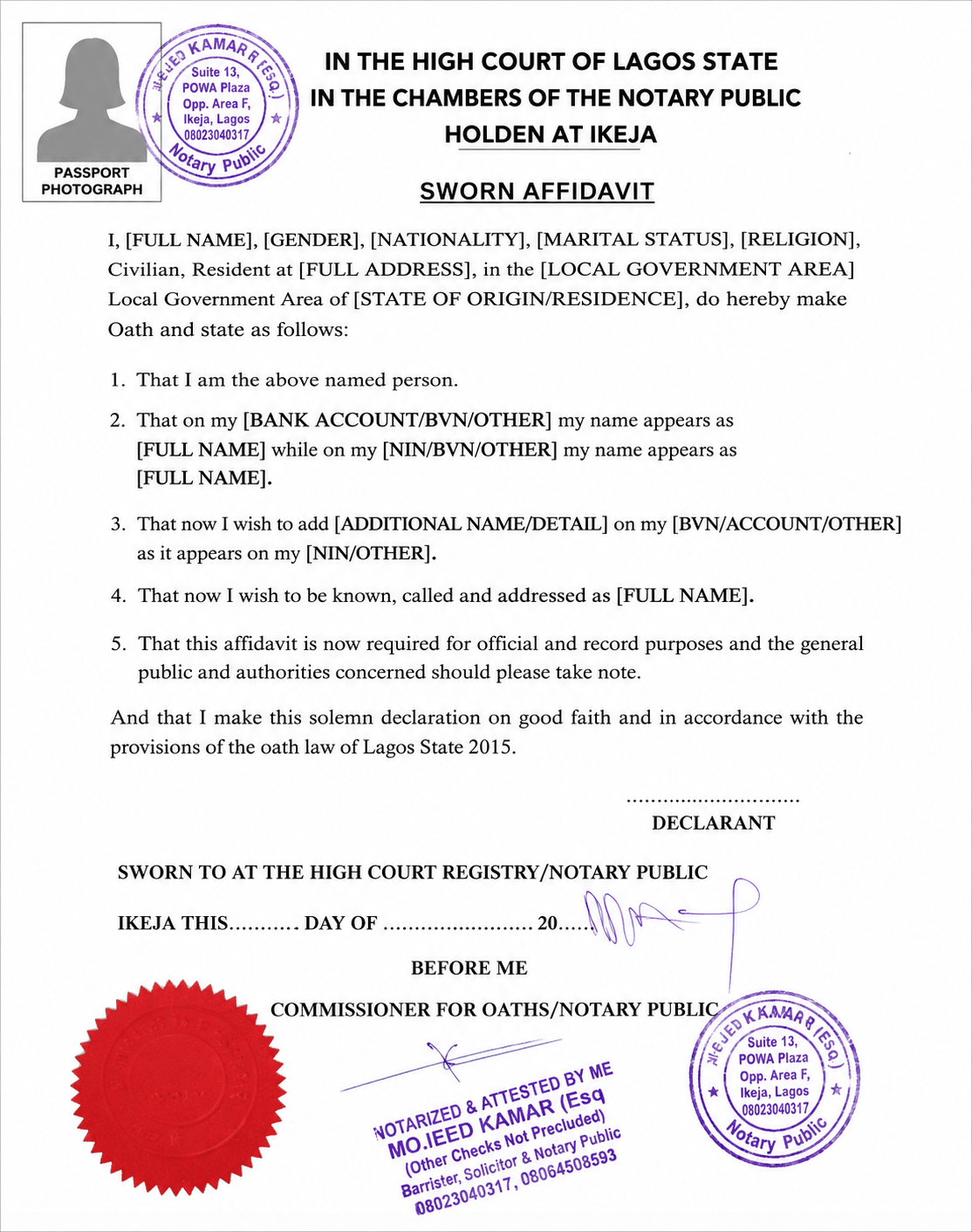
Get Your Affidavit Processed Quickly and Professionally
Obtain sworn affidavits for name changes, loss of documents, correction of information, age declaration, and other legal declarations with expert assistance.
Request an AffidavitWhy Nigerian Law Requires an Affidavit for Marriage Certificate
Nigerian marriage law exists to protect the legal validity of every union registered under the Marriage Act, CAP M6, Laws of the Federation of Nigeria 2004. A Registrar cannot issue a certificate to marry without satisfying one core condition: a sworn affidavit confirming that no impediment, whether an existing marriage, a family relationship, or another legal barrier, stands in the way of the union.
An affidavit for marriage certificate serves as the legal safeguard behind this requirement. Couples who skip or mishandle this step risk delaying their entire registration process, since the Marriage Registry cannot legally proceed without it.
Types of Affidavits Needed for Marriage Certificate Registration
Nigerian marriage registries request different sworn declarations depending on each party’s personal history. Understanding which type of affidavit for marriage certificate applies to a specific situation matters significantly before starting the registration process.
| Affidavit Type | Who Needs It | What It Declares |
| Affidavit of Bachelorhood | Unmarried men | Confirms the man has never married before |
| Affidavit of Spinsterhood | Unmarried women | Confirms the woman has never married before |
| Affidavit of Non-Impediment | Both parties, particularly for Special Marriage | Confirms no legal, custom, or traditional barrier prevents the marriage |
| Affidavit of Marriage | Previously married applicants | Declares an existing or past marriage |
| Sworn Affidavit of Single with Child/Children | Single applicants with children | Confirms single status while acknowledging existing children |
Each affidavit for marriage certificate serves a distinct legal purpose, and the Registry typically requests the specific type matching each applicant’s marital history, rather than a single generic document covering every scenario.
The Legal Basis: Marriage Act CAP M6 and the Oaths Act
Two Nigerian laws govern every affidavit for marriage certificate. The Marriage Act, CAP M6, Laws of the Federation of Nigeria 2004, establishes the formal requirements for statutory marriage, including the mandatory sworn declaration a Registrar must receive before issuing a certificate to marry. Section 33 of this Act specifically prohibits any Nigerian marriage where either party remains married by native law or custom to someone else at the time of the ceremony.
Alongside this, the Oaths Act, Laws of the Federation of Nigeria (LFN) 2004, governs the actual swearing process. A Commissioner for Oaths or a court witnesses the affidavit, confirming the deponent’s identity and understanding before validating the sworn declaration. Together, these two laws shape every affidavit for marriage certificate a Nigerian couple needs to complete their registration.

Documents Required Alongside Your Affidavit for Marriage Certificate
Beyond the affidavit itself, Nigerian marriage registries typically request a broader set of supporting documents. General requirements include:
- Birth certificate or Declaration of Age
- Passport photograph
- Indigene letter or letter of identification from state of origin, for Nigerian applicants
- Data page of international passport, for applicants living abroad
- Arrival passport stamp page, for applicants living abroad
- Residence permit, for applicants living abroad
Applicants with a previous marriage face additional requirements, including evidence of divorce (Decree Nisi and Decree Absolute), a death certificate for a deceased former spouse, or evidence of annulment from a Federal High Court, alongside the standard affidavit for marriage certificate.
Step-by-Step: How to Get an Affidavit for Marriage Certificate
Follow this sequence to complete the process correctly ahead of a wedding date:
- Determine your marital status category. Confirm whether you need an affidavit of bachelorhood, spinsterhood, non-impediment, or marriage, based on your personal history.
- Gather supporting documents. Collect your birth certificate, passport photograph, and identification documents relevant to your specific category.
- Visit a High Court, Magistrate Court, or Notary Public. Locate a Commissioner for Oaths authorized to witness your affidavit for marriage certificate.
- Swear the affidavit. State your marital status accurately, and sign the declaration under oath.
- Submit a Letter of Marriage Intention to the Registry. File this notice at the relevant local public registry, alongside a fee of ₦2,000.
- Wait through the notice period. The Registry displays the marriage notice publicly, typically for 21 days for Ordinary Marriage.
- Attend oath-taking a day before the ceremony. Both parties return to the Registry to formally confirm their affidavits before the wedding date.
- Collect the marriage certificate. Once the ceremony concludes, the Registry issues the official certificate.
Following this sequence carefully prevents the common frustration of arriving at the Registry without a properly sworn affidavit for marriage certificate already in hand.
Get Your Affidavit Processed Quickly and Professionally
Obtain sworn affidavits for name changes, loss of documents, correction of information, age declaration, and other legal declarations with expert assistance.
Request an Affidavit
Affidavit for Marriage Certificate: Ordinary vs Special Marriage
Nigerian law distinguishes between two categories of statutory marriage, and the affidavit requirements shift slightly depending on which applies.
| Marriage Type | Who It Applies To | Affidavit Requirements |
| Ordinary Marriage | Two Nigerian citizens | Affidavit of Bachelorhood or Spinsterhood generally suffices |
| Special Marriage | A Nigerian and a non-Nigerian, or two non-Nigerians | Affidavit of Non-Impediment required in addition to standard affidavits |
An Ordinary Marriage notice typically displays for 21 days, while a Special Marriage notice displays for a shorter 7-day period, though both categories require a properly sworn affidavit for marriage certificate before the Registry proceeds.
What If You Are Divorced, Widowed, or Previously Married?
Applicants who have married before need a different affidavit for marriage certificate than first-time applicants. Depending on the specific circumstances, the Registry typically requests:
- Divorced applicants: Evidence of Divorce, including Decree Nisi and Decree Absolute, alongside an Affidavit of Marriage acknowledging the prior union
- Widowed applicants: A death certificate for the previous spouse, alongside the standard affidavit confirming current single status
- Annulled marriages: Evidence of Annulment from a Federal High Court, supporting the affidavit declaration
- Single applicants with children: A Sworn Affidavit of Single with Child/Children, confirming single status while acknowledging existing children
Selecting the correct affidavit for marriage certificate category based on personal history prevents delays at the Registry, since submitting the wrong declaration type commonly triggers rejection or requests for additional documentation.
Single Status Certificate: When You Need One for Use Abroad
Nigerians planning to marry outside the country face an additional requirement: a single status certificate, itself a form of affidavit for marriage certificate purposes, confirming the Nigerian Marriage Registry holds no record of the applicant’s existing marriage.
The process for obtaining this document involves:
- Swear an Affidavit of Spinsterhood or Bachelorhood. Complete this step before a Commissioner for Oaths, just as with a standard domestic marriage affidavit.
- Submit the affidavit to the Ministry of Foreign Affairs in Abuja. The Ministry authenticates the document for international use.
- Complete embassy legalization, where required. Some destination countries request additional attestation from their embassy or consulate in Nigeria.
This document goes by several names internationally, including a Certificate of No Impediment, Certificate of Legal Capacity to Contract Marriage, or Single Status Statutory Declaration, though it functions as the same underlying affidavit for marriage certificate purposes recognized under Nigerian law.
Cost and Timeline
Costs and processing timelines vary by state and Registry office, but general estimates include:
- Court affidavit fee: A few hundred to a few thousand naira, depending on the court and location
- Marriage notice registration fee: ₦2,000, payable at the local public registry
- Single status certificate authentication (MFA): Additional fee, varying by processing channel
- Notice period: 21 days for Ordinary Marriage, 7 days for Special Marriage
Applicants who prepare their affidavit for marriage certificate well ahead of their intended wedding date avoid the common stress of rushing through the Registry’s mandatory notice period at the last minute.
How Nigerians Abroad Can Get an Affidavit for Marriage Certificate
Nigerians living in London, Houston, Toronto, or elsewhere abroad, planning to marry in Nigeria or seeking a single status certificate for use overseas, face a few additional practical considerations:
- Confirm which court or platform supports remote affidavit swearing. Several Nigerian states now operate e-Affidavit platforms allowing remote identity verification.
- Prepare data page copies of your international passport. The Registry specifically requests this alongside arrival stamp pages and residence permits for applicants living abroad.
- Plan around the 21-day notice period. Applicants traveling to Nigeria specifically for their wedding should factor this waiting period into their travel schedule.
- Coordinate MFA authentication in advance, if the affidavit needs recognition outside Nigeria for a marriage taking place abroad.
Managing an affidavit for marriage certificate across time zones and unfamiliar Registry procedures creates real pressure, particularly when a wedding date and travel plans depend on getting every document right the first time.
Common Mistakes to Avoid
- Choosing the wrong affidavit category. Submitting a bachelorhood affidavit when an applicant has previously married commonly triggers rejection at the Registry.
- Missing the notice period timeline. Failing to account for the 21-day (or 7-day) waiting window can push a wedding date back unexpectedly.
- Skipping MFA authentication for international use. A single status certificate intended for use abroad without proper Ministry of Foreign Affairs authentication often gets rejected by foreign authorities.
- Providing inconsistent personal details. Any mismatch between the affidavit and other identification documents can delay Registry processing.
- Waiting until the last minute. Given the mandatory notice period, starting the affidavit process early protects against unexpected delays close to a wedding date.
Why Choose DocuTrust Africa for Your Affidavit Process
Understanding exactly which affidavit for marriage certificate applies to a specific situation, and completing it correctly ahead of a wedding date, takes real coordination. DocuTrust Africa handles affidavit services for name correction, single status declarations, and other sworn declarations, guiding couples through Nigeria’s Marriage Registry requirements from start to finish.
Whether a couple lives in Lagos or one partner logs in from London, Houston, or Toronto, DocuTrust Africa’s five-step process consultation, requirement review, document submission, processing support, and confirmation removes the guesswork from obtaining the correct affidavit for marriage certificate. The team confirms exactly which declaration type applies, coordinates court swearing, and handles MFA authentication for couples marrying abroad. Reach the team at support@docutrustafrica.com or +234 704 029 4819, or start an application through the DocuTrust Africa portal.
Conclusion
Getting married under Nigerian law starts with one legal requirement most couples underestimate until it threatens their timeline: a properly sworn affidavit for marriage certificate. Backed by the Marriage Act, CAP M6, and the Oaths Act 2004, this sworn declaration confirms no legal impediment stands in the way of a union, whether that means an affidavit of bachelorhood, spinsterhood, non-impediment, or marriage.
Choosing the correct affidavit category based on personal history, preparing supporting documents early, and accounting for the mandatory 21-day notice period all protect a couple’s wedding timeline from unnecessary delay. Nigerians abroad, whether marrying in Nigeria or seeking a single status certificate for a wedding overseas, can navigate this process with careful planning around court access and MFA authentication. For couples who want every document handled correctly and on time, DocuTrust Africa stands ready to guide the entire journey, from the first sworn declaration to the final marriage certificate in hand.
Get Your Affidavit Processed Quickly and Professionally
Obtain sworn affidavits for name changes, loss of documents, correction of information, age declaration, and other legal declarations with expert assistance.
Request an Affidavit
Frequently Asked Questions on Affidavit for Marriage Certificate
What is an affidavit for marriage certificate used for?
It serves as a sworn legal declaration confirming a person’s marital status, satisfying the Marriage Act’s requirement that no impediment stands in the way of a couple’s marriage before the Registrar issues a certificate.
Which affidavit do I need if I have never married before?
Unmarried men typically need an Affidavit of Bachelorhood, while unmarried women need an Affidavit of Spinsterhood, both sworn before a Commissioner for Oaths.
Does a Special Marriage require additional affidavits?
Yes. Special Marriage, involving a non-Nigerian party, generally requires an Affidavit of Non-Impediment alongside the standard bachelorhood or spinsterhood declaration.
What if I am divorced or widowed?
Divorced applicants typically need evidence of divorce alongside an Affidavit of Marriage, while widowed applicants need a death certificate for their previous spouse alongside their affidavit confirming current status.
Do Nigerians abroad need a different type of affidavit for marriage certificate?
Nigerians marrying outside the country often need a single status certificate, a specific form of affidavit authenticated by the Ministry of Foreign Affairs for international recognition.
How long does the Marriage Registry notice period take?
Ordinary Marriage requires a 21-day public notice period, while Special Marriage requires a shorter 7-day period before the Registry proceeds.
Can Nigerians abroad complete this process remotely?
Yes, in many cases. Several Nigerian courts now support remote affidavit swearing through e-Affidavit platforms, though applicants should confirm this option with the specific court or Registry involved.
References
- Marriage under the Act — Intergovernmental Marriage Registry
- Marriage Certificate in Nigeria and Requirements — Publish.com.ng
- Marriage Registry in Nigeria (Court Marriage) — Veraz Advocates
- Overview of Affidavit of Spinsterhood or Bachelorhood and Affidavit of Non-impediment — Veraz Advocates
- Attestation of Marital Status in Nigeria: What is a Single Status Certificate? —Starlion Legal
- How to register a marriage in Nigeria — Australian Embassy Nigeria
- Marriage Overview — Citizenship and Business Department
- Marriage Act, CAP M6, Laws of the Federation of Nigeria 2004
- Oaths Act, Laws of the Federation of Nigeria (LFN) 2004