
Under Section 11(1) of Nigeria’s Marriage Act, a registrar cannot issue a marriage certificate until receiving a sworn affidavit confirming residency, proper age or parental consent, and the absolute lack of any legal impediment or existing marriage. Countless couples discover this exact requirement only weeks before their wedding date, scrambling to find a court, draft the correct wording, and swear the declaration before the Registry’s mandatory notice period even begins. Miss this step, and an entire cross-border wedding stalls: venue deposits sit unused, visa timelines slip, and travel plans built around a specific date suddenly hang in limbo. Add a Nigerian marrying abroad, who needs this same document authenticated for a foreign country’s marriage registry, and the pressure multiplies fast, since the affidavit alone rarely satisfies international requirements without further government authentication.
Anyone racing toward a Special Marriage keeps asking the same urgent questions:
- What exactly does an affidavit of non impediment need to state?
- Who can legally swear this document, and where do they go to get it?
- Does this affidavit alone satisfy a foreign country’s marriage requirements?
- Can a Nigerian abroad complete this requirement without flying home?
- What happens if the affidavit gets submitted with an error close to the wedding date?
Chasing scattered wedding forum advice rarely resolves these questions with the confidence a tight timeline demands. This guide breaks down exactly what an affidavit of non impediment requires, who needs one, and how the document gets used across Nigerian and international marriage processes. DocuTrust Africa takes it further, handling the affidavit, the authentication, and the documentation, so couples at home and abroad walk into their Registry or embassy appointment fully prepared.
Get Your Affidavit Processed Quickly and Professionally
Obtain sworn affidavits for name changes, loss of documents, correction of information, age declaration, and other legal declarations with expert assistance.
Request an AffidavitWhat Is an Affidavit of Non-Impediment?
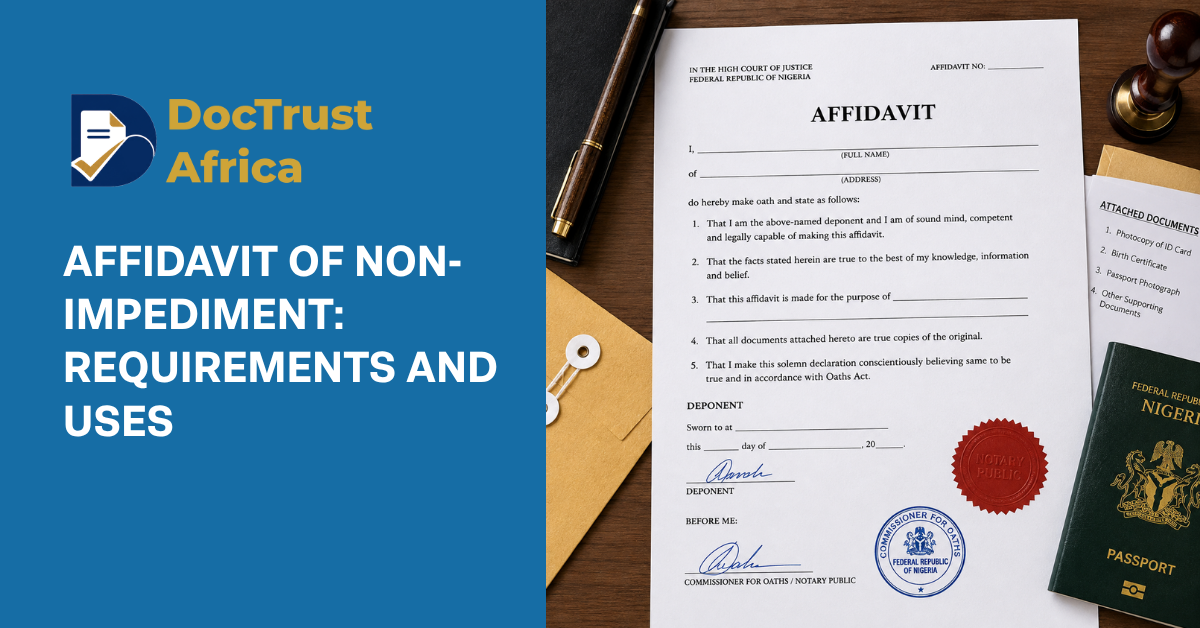
An affidavit of non impediment stands as a sworn legal declaration confirming that no legal, customary, or personal barrier prevents a specific marriage from taking place. The deponent states, under oath, that they hold no existing marriage, no close blood relationship with their intended spouse, and no other legal obstacle standing in the way of the union.
Nigerian marriage registries rely on this affidavit of non impediment specifically for Special Marriage cases, where at least one party involved is not a Nigerian citizen. The document gives the Registrar legal assurance that the marriage can proceed without violating the Marriage Act’s core requirements.
The Legal Basis: Marriage Act CAP M6 and the Oaths Act
Two Nigerian laws govern every affidavit of non impediment. The Marriage Act, CAP M6, Laws of the Federation of Nigeria 2004, establishes the formal requirements for statutory marriage in Nigeria, including the specific provisions under Section 33 that prohibit any marriage where a legal impediment exists between the parties.
Alongside this, the Oaths Act, Laws of the Federation of Nigeria (LFN) 2004, governs the actual swearing process. A Commissioner for Oaths or a Notary Public witnesses the affidavit of non impediment, confirming the deponent’s identity before validating the sworn declaration. Together, these two laws shape the entire legal framework behind this document, from its wording to its recognition by Nigerian marriage registries.
When Do You Need an Affidavit of Non-Impediment?
Several specific situations call for an affidavit of non impediment, and recognizing which one applies helps applicants prepare the correct supporting evidence.
| Situation | Why the Affidavit Applies |
| Special Marriage between a Nigerian and a foreign national | The Marriage Act requires this specific declaration for cross-nationality unions |
| Marriage between two foreign nationals in Nigeria | Both parties need to confirm no impediment exists under their respective laws |
| Nigerians marrying abroad | Some foreign jurisdictions request a Nigerian-issued affidavit of non impediment before recognizing the marriage |
| Correcting or updating marital status records | Certain institutions request this affidavit alongside other supporting documents |
Understanding exactly which scenario applies prevents applicants from submitting the wrong type of sworn declaration to a Nigerian Registry or a foreign embassy.
Who Can Swear an Affidavit of Non-Impediment?
Nigerian law authorizes specific officials to witness and validate an affidavit of non impediment, consistent with the broader Oaths Act framework:
- A Commissioner for Oaths at a High Court or Magistrate Court
- A Notary Public
- Judges of the Federal High Court, Court of Appeal, and Supreme Court, in specific circumstances
The deponent must appear personally before one of these officials, confirming their identity and understanding of the declaration before signing under oath. This personal appearance requirement matters significantly, since an affidavit of non impediment sworn improperly, or witnessed by an unauthorized party, carries no legal weight before a Nigerian marriage registry.
Requirements for Obtaining an Affidavit of Non-Impediment
Gathering the right documents before visiting court speeds up the entire process considerably. Standard requirements include:
| Requirement | Purpose |
| Valid means of identification | Confirms the deponent’s identity to the Commissioner for Oaths |
| Passport photograph | Attached to the sworn document |
| Data page of international passport | Required for applicants involved in cross-nationality marriages |
| Details of the intended spouse | Establishes the specific union the affidavit supports |
| Evidence of current marital status | Where applicable, supports the declaration of no existing impediment |
Applicants preparing an affidavit of non impediment for a Special Marriage should also gather any additional identification documents their intended foreign spouse’s embassy might separately request.
Step-by-Step: How to Get an Affidavit of Non-Impediment
Follow this sequence to obtain a valid, legally recognized document:
- Confirm your marital status category. Establish whether this is your first marriage, and gather any relevant supporting evidence if not.
- Gather your identification and supporting documents. Collect your passport, passport photograph, and details of your intended spouse.
- Visit a High Court, Magistrate Court, or Notary Public. Locate a Commissioner for Oaths authorized to witness your declaration.
- Swear the affidavit of non impediment. State the declaration accurately, confirming no legal barrier exists to the intended marriage.
- Collect your signed and sealed document. The Commissioner stamps and seals the affidavit, giving it full legal recognition.
- Submit the affidavit alongside your marriage notice. File this document with your other supporting evidence at the relevant local public registry.
Following this sequence carefully prevents the common frustration of arriving at a Registry appointment without a properly sworn affidavit of non impediment already in hand.
Affidavit of Non-Impediment for Special Marriage
Nigerian law distinguishes Special Marriage, involving at least one non-Nigerian party, from Ordinary Marriage between two Nigerian citizens. This distinction directly determines whether an affidavit of non impediment becomes a mandatory requirement.
| Marriage Type | Affidavit of Non-Impediment Required? | Notice Period |
| Ordinary Marriage (two Nigerian citizens) | Generally not required; bachelorhood/spinsterhood affidavit suffices | 21 days |
| Special Marriage (one or both parties non-Nigerian) | Required | 7 days |
The shorter 7-day notice period for Special Marriage might suggest a faster process overall, but gathering a properly sworn affidavit of non impediment, along with supporting documentation from a foreign national spouse, often takes longer in practice than the notice period itself.
Using an Affidavit of Non-Impediment Internationally
Nigerians planning to marry outside the country, or foreign nationals planning to marry in a jurisdiction that requires proof of Nigerian marital status, often need this document authenticated beyond its original court seal. The typical process involves:
- Swear the affidavit of non impediment before a Commissioner for Oaths. Complete this step exactly as required for domestic use.
- Submit the affidavit to the Federal Ministry of Foreign Affairs in Abuja. The Ministry authenticates the document for international recognition.
- Complete embassy legalization, where required. Some destination countries request additional attestation from their embassy or consulate in Nigeria before accepting the document.
This affidavit often travels under different names internationally, sometimes called a Certificate of No Impediment or Certificate of Legal Capacity to Contract Marriage, though the underlying legal function remains the same as the Nigerian affidavit of non impediment.
Get Your Affidavit Processed Quickly and Professionally
Obtain sworn affidavits for name changes, loss of documents, correction of information, age declaration, and other legal declarations with expert assistance.
Request an AffidavitCost and Timeline
Costs and processing timelines vary by court, location, and whether international authentication applies. General estimates include:
- Court affidavit fee: A few hundred to a few thousand naira, depending on the court
- Ministry of Foreign Affairs authentication fee: Additional charge, varying by processing channel
- Embassy legalization fee, where applicable: Varies significantly by destination country
- Overall timeline: A few hours to a full day for the initial swearing; several additional days for full international authentication
Applicants who prepare their affidavit of non impediment well ahead of an intended wedding date avoid the common stress of rushing through both the Nigerian court process and any required international authentication at the last minute.
Common Uses Beyond Marriage
While marriage remains the primary context, an affidavit of non impediment occasionally supports other legal declarations requiring confirmation that no barrier prevents a specific action or arrangement. Some institutions request a similarly structured sworn statement for:
- Confirming eligibility for certain professional licenses or appointments
- Supporting specific property or business transactions requiring a declaration of no conflicting legal claim
- Backing up certain immigration or visa applications that request confirmation of an applicant’s unencumbered legal status
Though marriage remains the dominant use case, understanding that courts can adapt the underlying affidavit of non impediment structure for other declarations helps applicants recognize the document’s broader legal utility.
How Nigerians Abroad Can Obtain an Affidavit of Non-Impediment
Nigerians living in London, Houston, Toronto, or elsewhere abroad, planning either a Special Marriage in Nigeria or a wedding overseas requiring Nigerian-issued documentation, face a few additional practical considerations:
- Confirm which court or e-Affidavit platform supports remote swearing. Several Nigerian states now operate platforms allowing remote identity verification for sworn declarations.
- Prepare scanned, high-resolution copies of your passport and supporting documents. Registries and embassies both typically request clear, legible copies.
- Plan around notice periods and authentication timelines together. A Special Marriage’s 7-day notice period, combined with Ministry of Foreign Affairs authentication, can extend the overall timeline significantly.
- Coordinate directly with your destination country’s embassy, if using the affidavit of non impediment for a marriage taking place outside Nigeria.
Managing this affidavit across time zones and unfamiliar registry procedures creates real pressure, particularly when a wedding date, travel plans, and visa timelines all depend on getting every document right the first time.
Verifying a Properly Sworn Affidavit of Non-Impediment
Institutions increasingly scrutinize sworn documents before accepting them, given the rise of fraudulent affidavits circulating outside official court channels. A genuine affidavit of non impediment should carry specific markers of authenticity:
- An official court stamp and seal from the issuing Commissioner for Oaths
- A unique reference or file number tied to the specific court registry
- The Commissioner’s signature, matching records held at that specific court
- Consistent formatting matching the court’s standard affidavit template
- Accurate personal details matching the deponent’s other identification documents exactly
Applicants unsure whether their affidavit of non impediment meets these standards should confirm directly with the issuing court, particularly before submitting the document to a foreign embassy or the Ministry of Foreign Affairs for authentication. A document that fails this verification step at any stage can derail an otherwise carefully planned wedding timeline.
Special Considerations for Multiple Nationalities
Couples where both parties hold different foreign nationalities, neither of them Nigerian, occasionally still process their marriage through a Nigerian registry, particularly if both parties currently reside in Nigeria. In these cases, an affidavit of non impediment may need to satisfy requirements from multiple legal systems simultaneously.
A few practical points help couples navigate this more complex scenario:
- Confirm requirements with both parties’ respective embassies. Some countries request their own specific format or additional certification beyond Nigeria’s standard affidavit of non impediment.
- Budget extra time for coordinating multiple authentication steps. A marriage involving two foreign nationalities sometimes requires legalization from two separate embassies.
- Keep certified copies of every version submitted. Different institutions may retain their own copy of the affidavit, so applicants should keep their own record throughout the process.
Working through these additional considerations early prevents last-minute surprises for couples whose situation extends beyond the standard Nigerian-foreign national pairing.
Common Mistakes to Avoid
- Confusing Ordinary Marriage requirements with Special Marriage requirements. Submitting a standard bachelorhood affidavit instead of an affidavit of non impediment for a cross-nationality marriage commonly triggers rejection.
- Skipping Ministry of Foreign Affairs authentication for international use. An affidavit of non impediment intended for use abroad, without proper MFA authentication, often gets rejected by foreign authorities.
- Providing inconsistent personal details. Any mismatch between the affidavit and other identification documents can delay Registry or embassy processing.
- Underestimating the timeline for international authentication. Applicants planning a wedding abroad should account for both the court process and the additional authentication steps.
- Waiting until the last minute. Given the notice period and potential authentication requirements, starting the process early protects against unexpected delays close to a wedding date.
Why Choose DocuTrust Africa
Understanding exactly what an affidavit of non impediment requires, and getting it correctly sworn and, where necessary, authenticated ahead of a wedding date, takes real coordination. DocuTrust Africa handles affidavit services for marriage-related declarations, alongside document authentication for embassy verification and international use.
Whether a couple lives in Lagos or one partner logs in from London, Houston, or Toronto, DocuTrust Africa’s five-step process consultation, requirement review, document submission, processing support, and confirmation removes the guesswork from obtaining a properly sworn affidavit of non impediment. The team coordinates court swearing, Ministry of Foreign Affairs authentication, and embassy legalization for couples marrying internationally. Reach the team at support@docutrustafrica.com or +234 704 029 4819, or start an application through the DocuTrust Africa portal.
Conclusion
Marrying across nationalities under Nigerian law starts with one specific legal requirement most couples underestimate until it threatens their timeline: a properly sworn affidavit of non impediment. Backed by the Marriage Act, CAP M6, and the Oaths Act 2004, this sworn declaration confirms no legal barrier stands between two people planning a Special Marriage, whether that marriage takes place in Nigeria or requires recognition abroad.
Understanding when this specific affidavit applies, gathering accurate supporting documents, and planning for both the Registry’s notice period and any required international authentication all protect a couple’s wedding timeline from unnecessary delay. Nigerians abroad, whether marrying in Nigeria or seeking recognition for a wedding overseas, can navigate this process with careful planning around court access and Ministry of Foreign Affairs authentication. For couples who want every document handled correctly and on time, DocuTrust Africa stands ready to guide the entire journey, from the first sworn declaration to final international recognition.

Get Your Affidavit Processed Quickly and Professionally
Obtain sworn affidavits for name changes, loss of documents, correction of information, age declaration, and other legal declarations with expert assistance.
Request an AffidavitFrequently Asked Questions on Affidavit of Non Impediment
What is an affidavit of non impediment used for?
It confirms, under oath, that no legal, customary, or personal barrier prevents a specific marriage, satisfying the Marriage Act’s requirements for Special Marriage cases involving a non-Nigerian party.
Who needs an affidavit of non impediment?
Couples where at least one party is not a Nigerian citizen typically need this affidavit before the Marriage Registry can issue a certificate to marry.
Where can I swear an affidavit of non impediment?
A Commissioner for Oaths at a High Court or Magistrate Court, or a Notary Public, can witness and validate this sworn declaration.
Do I need to authenticate my affidavit of non impediment for use abroad?
Yes, in most cases. Using this document outside Nigeria typically requires authentication from the Ministry of Foreign Affairs, and sometimes additional embassy legalization.
How long does it take to obtain an affidavit of non impediment?
The initial swearing typically takes a few hours to a full day, though international authentication can add several additional days to the overall timeline.
Can Nigerians abroad obtain an affidavit of non impediment remotely?
Yes, in many cases. Several Nigerian courts now support remote affidavit swearing through e-Affidavit platforms, though applicants should confirm this option with their specific court.
What is the difference between an affidavit of non impediment and a single status certificate?
Both documents confirm marital status for legal purposes, but an affidavit of non impediment specifically supports Special Marriage under Nigerian law, while a single status certificate more broadly confirms unmarried status, often for international recognition purposes.
References
- Marriage under the Act — Intergovernmental Marriage Registry
- Marriage Registry in Nigeria (Court Marriage) — Veraz Advocates
- Overview of Affidavit of Spinsterhood or Bachelorhood and Affidavit of Non-impediment — Veraz Advocates
- Marriage Certificate in Nigeria and Requirements — Publish.com.ng
- Attestation of Marital Status in Nigeria: What is a Single Status Certificate? — Starlion Legal
- Marriage Act, CAP M6, Laws of the Federation of Nigeria 2004
- Oaths Act, Laws of the Federation of Nigeria (LFN) 2004