
For Ada, everything was ready. She had secured admission to her dream university abroad, paid her acceptance fees, and scheduled her visa appointment. Then she received one final instruction: “All supporting documents must be authenticated.” Like many applicants before her, she paused and searched online for authentication of documents in Nigeria and how do you authenticate documents, only to find conflicting information that raised more questions than answers.
Stories like Ada’s are common. Every year, countless Nigerians experience delays because they misunderstand the authentication process, visit the wrong office, or submit incomplete documents. These mistakes not only increase costs but can also jeopardize opportunities that people have worked hard to achieve.
Fortunately, document authentication is much simpler when you understand the correct process. With trusted documentation support providers like DocuTrust Africa helping applicants navigate the requirements, the journey becomes clearer and less overwhelming. In this article, you’ll learn what document authentication means, why it’s important, how the process works, what it costs, and how to prepare your documents for successful embassy verification.
What Is Document Authentication?
The authentication of documents in Nigerian is the official process of verifying that a document is genuine and legally recognized for use by another institution or country. During this process, the appropriate government authority confirms the authenticity of a document, its signature, seal, or issuing body before it can be accepted for official purposes.
Furthermore, document authentication is commonly required when individuals intend to study, work, relocate, conduct business, get married abroad, or complete immigration and embassy-related applications. Depending on the destination country and the type of document, the authentication process may involve one or more government agencies before the document is presented to a foreign embassy or consulate.

Why Is Document Authentication Important?
The authentication of documents in Nigeria is more than just an administrative requirement, it’s a critical step that gives your documents legal credibility for international use.
Some of the key reasons why document authentication is important include:
- Ensures international recognition: Authenticated documents are more likely to be accepted by foreign embassies, universities, employers, and government agencies.
- Reduces the risk of document rejection: Proper authentication confirms the legitimacy of your documents, helping you avoid unnecessary delays or repeated submissions.
- Protects against fraud: The authentication process verifies the authenticity of signatures, seals, and issuing authorities, making it more difficult for forged documents to be used.
- Supports visa and immigration applications: Many embassies require authenticated documents before processing visa, residency, or citizenship applications.
- Facilitates overseas education: Universities and educational institutions abroad often request authenticated academic certificates, transcripts, and other educational records.
- Simplifies international employment: Employers may require authenticated educational and professional documents before completing recruitment or work permit processes.
- Strengthens business transactions: Authenticated corporate documents help establish trust during international partnerships, company registrations, and contractual agreements.
- Provides peace of mind: Using a professional documentation support provider like DocuTrust Africa helps applicants navigate the authentication process with greater confidence while minimizing costly mistakes and unnecessary delays.
Authenticate Your Documents with Confidence
Professional assistance for document authentication, verification, certification, and legalization services to help ensure your documents are accepted by the required institutions and authorities.
Start AuthenticationWhich Documents Can Be Authenticated for Embassy Verification?
One of the first questions applicants ask is whether their documents qualify for embassy verification. Fortunately, the authentication of documents in Nigeria covers a wide range of personal, educational, corporate, and legal documents, provided they were issued by the appropriate authority and meet the relevant requirements.
Some of the most commonly authenticated documents include:
- Birth Certificates
- Marriage Certificates
- Educational Certificates (WAEC, NECO, NABTEB, ND, HND, Bachelor’s, Master’s, and PhD Certificates)
- Academic Transcripts
- NYSC Certificate of National Service or Exemption Certificate
- Police Character Certificate
- Medical Reports (where required)
- Court Affidavits
- Change of Name Documents
- Corporate Affairs Commission (CAC) Registration Documents
- Certificate of Incorporation
- Business Name Registration Documents
- Memorandum and Articles of Association
- Power of Attorney
- Deeds and Other Legal Documents
How Do You Authenticate Documents in Nigeria?
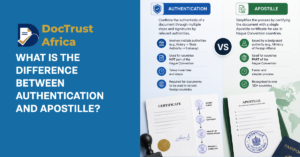
If you’re asking, “how do you authenticate documents?”. The process is straightforward when you understand the required steps. Typically, the exact procedure varies depending on the document type and the destination country. Because Nigeria is not part of the Hague Apostille Convention, the process relies on a step-by-step verification process.
Below are the procedures for the authentication of documents in Nigeria.
Standard Authentication Process
The general process for authenticating documents (such as birth, marriage, or business certificates) involves these steps:
- Notarization: Have your documents reviewed, signed, and stamped by a licensed Notary Public in Nigeria.
- Ministry of Foreign Affairs (MFA): Take the notarized documents to the Legal & Consular Department at the MFA Headquarters in Abuja. You must complete an application form, submit photocopies of your documents and international passport, and pay the prescribed processing fee.
- Embassy Legalization: For international use, take the MFA-authenticated documents to the embassy or consulate of your destination country within Nigeria for final attestation.
Academic and Educational Documents
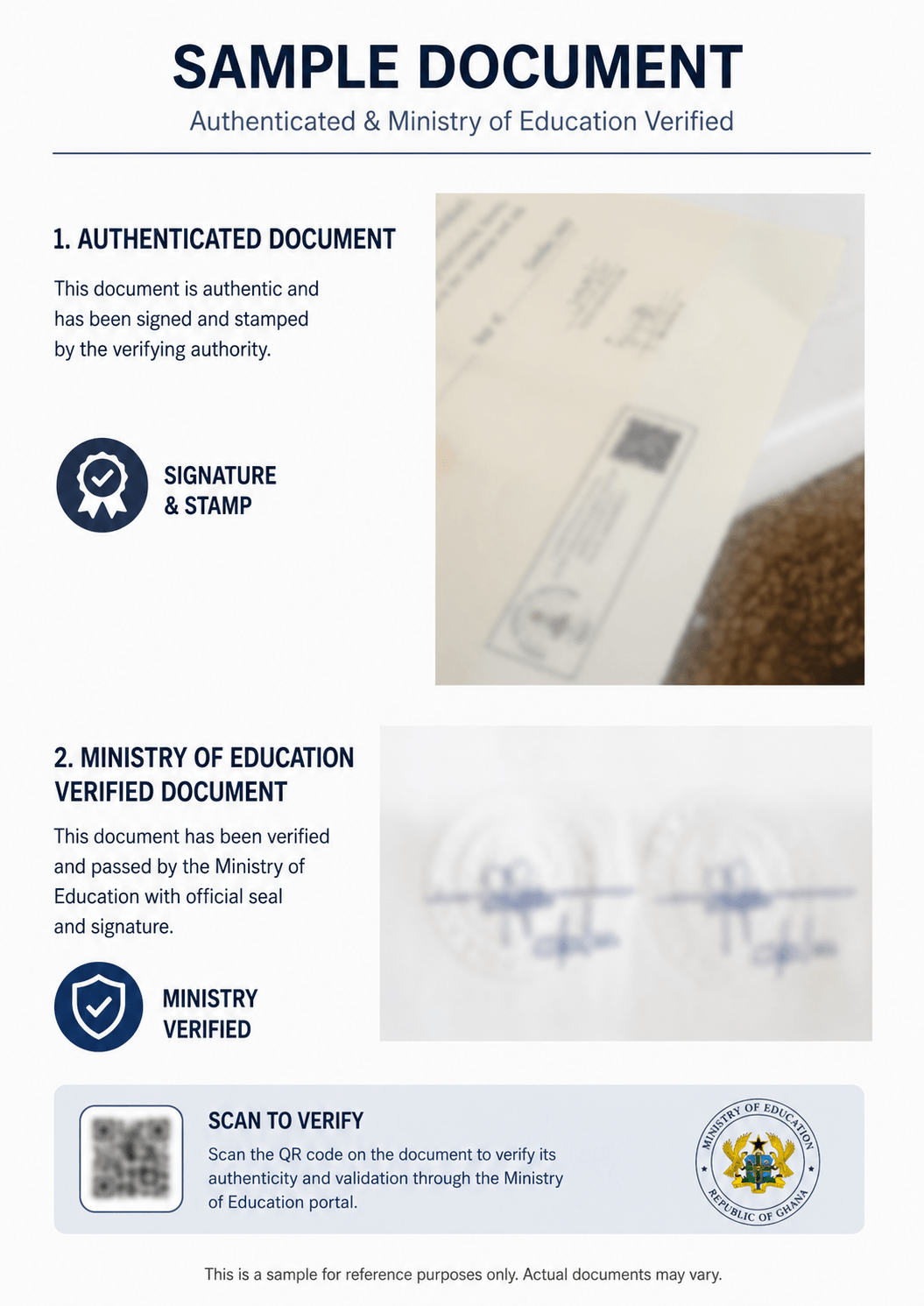
If you are authenticating educational certificates, degrees, or transcripts, you must first verify them with the Federal Ministry of Education (FMOE) before you can approach the MFA:
- School Verification: Request that your issuing institution (e.g., university or WAEC) send a verification email or transcript directly to the Ministry of Education.
- Ministry of Education Attestation: You can submit your documents online via the FMOE evaluation and accreditation portal. You will need your school’s verification letter, your original certificate, and a processing fee.
- MFA and Embassy: Once the FMOE authenticates the academic document, proceed to the Ministry of Foreign Affairs and the destination embassy.
Key Details to Note
- Location: Physical document submission for the MFA must be done at the headquarters in Abuja (Tafawa Balewa House, Central Business District). If you cannot travel, you must send a trusted representative with a formal letter of authorization.
- No Lamination: Do not laminate your original documents before taking them for authentication, as officials require unblemished originals to verify stamps and signatures.
- Processing Time: Processing generally takes between 2 and 5 working days depending on the volume and document type.
Docutrust Africa helps cover all these processes, without you moving an inch. Kindly reach to our team of experts to get started.
How Much Does Document Authentication Cost in Nigeria?
If you’re wondering about the authentication of documents in Nigeria, the cost depends on several factors. These factors include the type of document, the number of documents being processed, the government agencies involved, the destination country, and whether embassy legalization is also required.
Generally, official government fees for document authentication at the Federal Ministry of Foreign Affairs (MFA) in Abuja range from ₦2,000 to ₦5,000 per page. However, this is only one part of the overall process. Depending on the document type, page count, and destination country’s requirements, the total cost of authenticating and legalizing a document for international use typically falls between ₦17,000 and ₦45,000 or more per document after accounting for preliminary verification, applicable government charges, and other processing requirements.
For applicants who want a more convenient and guided experience, DocuTrust Africa provides professional document authentication support at competitive rates. We currently charge:
- ₦4,500 per page for document authentication at the Federal Ministry of Foreign Affairs (MFA).
- ₦5,000 per page for document authentication at the Federal Ministry of Education (FME).
Kindly note that these charges exclude applicable Remita payment fees, administrative fees, and service fees, which vary depending on the nature of the application and the documents being processed.
Where Can I Authenticate Documents in Nigeria for Embassy Verification?
Successfully completing the authentication of documents in Nigeria begins with knowing where your documents should be processed. Therefore, choosing the right processing channel from the outset can save time, reduce costs, and prevent unnecessary delays.
Here are the primary places where documents are authenticated in Nigeria:
- The Federal Ministry of Education (FME): Commonly authenticates educational documents such as certificates, diplomas, transcripts, and statements of result.
- The Federal Ministry of Foreign Affairs (MFA): Authenticates documents that are intended for international use after any required preliminary verification has been completed.
- Foreign Embassies or Consulates: Some countries require embassy or consular legalization after the document has been authenticated by the appropriate Nigerian authority.
- Other Issuing or Regulatory Authorities: Certain documents may need to be verified by the institution or agency that issued them before they can proceed for authentication.
- DocuTrust Africa: For individuals and businesses looking for a convenient, end-to-end solution, DocuTrust Africa offers professional document authentication support. Instead of navigating multiple offices alone, you’ll receive guidance on document requirements, application review, submission, and follow-up.
Authenticate Your Documents with Confidence
Professional assistance for document authentication, verification, certification, and legalization services to help ensure your documents are accepted by the required institutions and authorities.
Start AuthenticationCommon Mistakes to Avoid During the Authentication of Documents in Nigeria
The authentication of documents in Nigeria is a straightforward process when handled correctly. However, small mistakes can delay applications, increase costs, and even result in document rejection.
Here are common errors to avoid during documents authentication:
- Submitting incomplete documents.
- Failing to verify embassy requirements as every country has its own documentation requirements.
- Using damaged or unofficial documents.
- Providing inconsistent information like differences in names, dates of birth, or other personal details.
- Skipping required verification stages.
- Waiting until the last minute before starting.
- Attempting to navigate the process without guidance.
Frequently Asked Questions on How to Authenticate Documents in Nigeria
How long does document authentication take in Nigeria?
The processing time depends on the type of document, the government agencies involved, and whether embassy legalization is required. While some applications can be completed within 2 to 6 business days, others may take up to 3 weeks longer if additional verification is needed.
Can I authenticate educational certificates for use abroad?
Yes. Educational documents such as WAEC, NECO, NABTEB, university certificates, diplomas, transcripts, and other academic records can be authenticated for use abroad.
Can someone else process my document authentication on my behalf?
In many cases, yes. Applicants may authorize a trusted documentation service provider to assist with the authentication process, provided all required documents and authorizations are submitted.
Why should I use DocuTrust Africa for document authentication?
DocuTrust Africa offers professional support throughout the document authentication process. We are committed to reviewing your documents, explaining the requirements and coordinating submissions with the relevant authorities. Instead of going through multiple offices on your own, you benefit from a more streamlined process that helps reduce errors, save time, and improve your overall experience.
References
en.wikipedia.org: Hague Apostille Convention
education.gov.ng: Federal Ministry of Education
foreignaffirs.gov.ng: Federal Ministry of Foreign Affairs