
Imagine receiving an admission offer from a university abroad after months of applications. Your passport is ready, your finances are arranged, and your certificate is in your folder. Then you discover that the school requires an authenticated copy of your academic document. Suddenly, the question becomes: What are the documents required for authentication Nigeria? Knowing the answer early can help you avoid unnecessary delays when preparing documents for international use.
The Federal Ministry of Foreign Affairs identifies document authentication as a service for Nigerian documents intended for international use. They also list categories such as birth certificates, marriage certificates, child adoption documents, and other official documents. The need for authentication indicate a broader international challenge. A foreign institution needs a reliable way to establish the authenticity of documents issued in another country. The HCCH’s Apostille Convention was created partly to simplify this cross-border verification process.
Instead of discovering the requirements after your application has already been delayed, this article shows you what to prepare from the beginning. You’ll learn:
- Which documents require authentication in Nigeria.
- What you need for academic certificate authentication.
- How to prepare your documents before submission.
- Where to submit documents for authentication in Nigeria.
Why Is Document Authentication Necessary in Nigeria?
Document authentication in Nigeria is necessary to prove that official certificates, academic degrees, or legal papers are genuine. Because Nigeria is not a member of the Hague Apostille Convention, foreign authorities, embassies, and schools require a formal government stamp from the Ministry of Foreign Affairs to prevent fraud and accept the records.
Below are more reasons why it’s necessary:
- International Acceptance: Foreign universities, employers, and immigration offices require proof that Nigerian documents are not fake.
- Fraud Prevention: It confirms that signatures, seals, and issuing bodies are real and untampered.
- Visa and Migration Support: It’s essential for processing residency, work permits, and foreign visas.
- Legal and Business Use: Vital for cross-border adoption, marriages, or setting up foreign business branches
What Are the Documents Required for Authentication in Nigeria?
If you are preparing to study, work, relocate, marry, or handle legal or business matters abroad, you may eventually need to know the documents required for authentication in Nigeria. To authenticate documents in Nigeria for international use, you need the original document, and a Notary Public certification. You also need a completed request form, photocopies, your international passport data page, and the official Remita payment receipt. Meanwhile, the specific required documents depend on the category of record you are submitting.
Common documents that may require authentication include:
- Birth Certificate: Must be issued by the National Population Commission (if issued after 1992).
- Educational certificates and academic records
- Marriage or Divorce Certificate: Issued by a recognized marriage registry or court judgment.
- Police Character Certificate: Issued by the Nigerian Police Force.
- Single Status Affidavit: Sworn declaration of bachelorhood or spinsterhood
- Adoption documents
- Affidavits and other legal documents
- Corporate and business documents
List of Personal Documents That Can Be Authenticated
Your situation determines which authentication documents you need to prepare. If you are travelling, studying, getting married, relocating, or handling a family-related matter abroad, you may encounter requests for authentication of personal documents such as:
- Birth certificates: Used to establish identity, date of birth, or family relationships.
- Marriage certificates: Often requested when you need to prove your marital relationship for an overseas application.
- Adoption documents: May require authentication when used in international adoption or family-related proceedings.
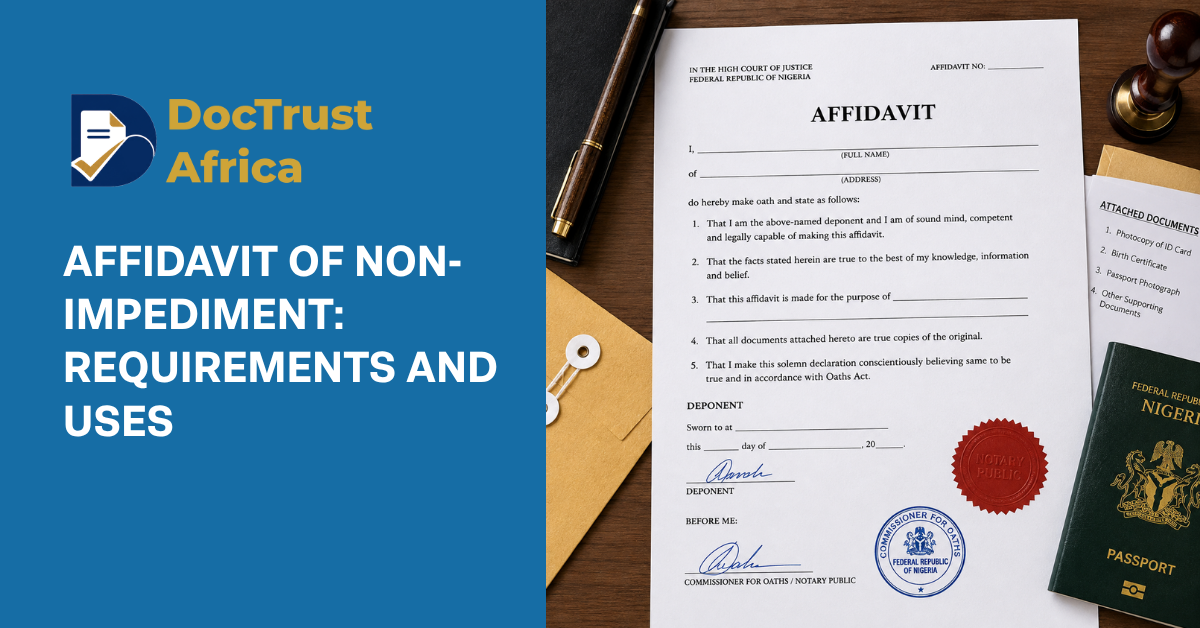
- Affidavits: Certain sworn declarations may require authentication when you intend to use them outside Nigeria.
- Certificates of change or correction of name: These may support applications where your name differs across official records.
- Educational certificates: Schools, employers, professional bodies, or foreign authorities may request authenticated academic documents.
Educational Documents Required for Authentication
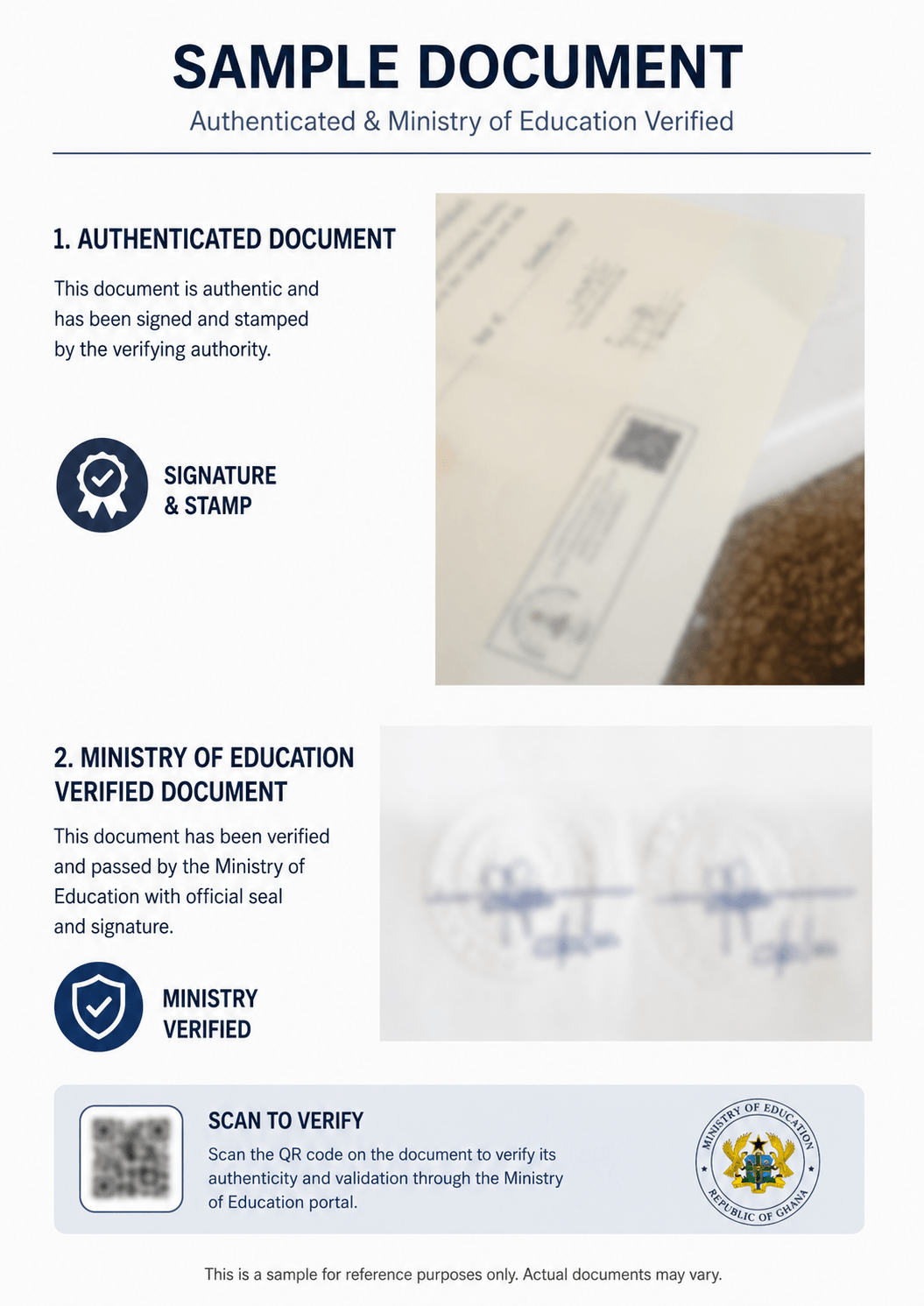
To authenticate educational documents in Nigeria for international use, you must submit your original academic certificates or transcripts along with a valid ID and proof of payment through the Evaluation and Accreditation System portal managed by the Federal Ministry of Education.
Common educational documents may include:
- Tertiary Qualifications: University degrees (BSc, Masters, PhD), Diplomas, Higher National Diplomas (HND), Ordinary National Diplomas (OND), and National Certificates in Education (NCE).
- Secondary School Certificates: WAEC, NECO, GCE, NABTEB, and NBAIS.
- Transcripts: Official academic records sent directly from your awarding university or school.
- Professional Certificates: Nursing, medical, or specialized corporate/professional body certifications.
Required Support Items for the Process
- Original Documents: Physical certificates matching your online application uploads.
- Identification: A valid government-issued means of identification, such as your National Identification Number (NIN) slip or International Passport data page.
- Institutional Verification: Academic transcripts requested from your school and sent directly to the Ministry’s official processing emails (such as ess1@education.gov.ng)
- Payment Receipts: RRR payment confirmation generated via the online portal.
Authenticate Your Documents with Confidence
Professional assistance for document authentication, verification, certification, and legalization services to help ensure your documents are accepted by the required institutions and authorities.
Start AuthenticationDocuments Required for Birth and Marriage Certificate Authentication
Planning to relocate, apply for a family visa, or submit your civil records to a foreign authority? You may need to authenticate your birth or marriage certificate before the receiving institution accepts it.
For birth certificate authentication, you may need:
- Original Document: Must be an official copy issued directly by the National Population Commission (NPC). If born before 1992, an NPC Attestation of Birth Letter is required.
- Supporting Proof: National Identification Number (NIN) or slip and a sworn age declaration affidavit if requested for old records.
- Identification: A valid government-issued photo ID (International Passport, National ID card, or Driver’s License).
Marriage Certificate Requirements
- Original Document: Must be issued by an authorized Local Government Marriage Registry, the Federal Ministry of Interior, or a recognized Federal/State Marriage Registry. Church or traditional marriage certificates must first be registered and converted/endorsed by a statutory marriage registry.
- Supporting Proof: Sworn affidavit of marriage or affidavit of marital status if applicable.
- Identification: Valid identification cards of both spouses or the applicant.
Documents Required for Legal and Business Document Authentication Nigeria
Legal and business documents often carry significant consequences when you use them outside Nigeria. The process involves notarization by a Notary Public, verification by relevant supervising ministries (such as Education or CAC), and final authentication at the Ministry of Foreign Affairs in Abuja.
Legal and personal documents required:
- Civil Status Documents: Birth certificates, death certificates, marriage certificates, and divorce decrees.
- Legal Declarations: Affidavits, court judgments, statutory declarations, and Powers of Attorney.
- Police Records: Police Character Certificates (PCC).
- Academic Records: Degree certificates, diplomas, and transcripts (which must first be cleared by the Federal Ministry of Education).
Business and commercial documents:
- Corporate Registration: Corporate Affairs Commission (CAC) documents, including Certificates of Incorporation, Memorandum and Articles of Association, and Status Reports (CAC Form CAC 1.1 or legacy forms).
- Financial & Tax Records: Tax Clearance Certificates (TCC) and audited financial statements or bank reference letters.
- Commercial Agreements: Board resolutions, partnership agreements, commercial invoices, and export/shipping documents (bills of lading).
How to Prepare the Documents for Authentication in Nigeria
Preparing the right paperwork can make document authentication in Nigeria much easier. Hence, before submitting your documents, first confirm what the foreign embassy, university, employer, immigration authority, or other organisation requires. The Federal Ministry of Foreign Affairs (MFA) provides authentication and legalisation services for Nigerian documents intended for international use.
Follow these steps to prepare your documents:
- Obtain the correct original or acceptable certified copy: Avoid submitting an ordinary photocopy when the relevant authority requires an original or certified document.
- Complete any required verification or certification first: Some documents may need verification by the issuing institution or relevant government authority before you proceed to MFA authentication.
- Check all information carefully: Confirm that your name, date of birth, certificate number, dates, signatures, and other details are accurate. Ensure to resolve discrepancies before authentication where possible.
- Check the destination country’s requirements: Authentication may not be the final step. Your destination country may also require embassy or consular legalisation, translation, or another form of verification.
- Use the MFA’s current online process where applicable: The MFA’s Consular and Legal Department platform allows applicants to register, select an authentication service, upload required documents, submit applications, and track their status.
Where to Submit Documents for Authentication in Nigeria
You can submit documents for authentication through the Federal Ministry of Foreign Affairs (MFA). The Ministry’s official contact information lists its office at Tafewa Balewa House, Central Business District, Abuja.
However, you should not assume that every application requires a physical visit. The MFA’s Consular and Legal Department (ACS) now provides an online platform for authentication and legalisation services. Through the platform, you can select the appropriate service, upload your documents, submit applications, and track your progress.
If you are outside Abuja or prefer professional assistance, DocuTrust Africa can help you prepare your documents and navigate the authentication process. This can be particularly useful when your document requires several preliminary steps before it reaches the MFA.
How Much Does Document Authentication Cost in Nigeria?
The official government fee for document authentication at the Ministry of Foreign Affairs (MFA) in Abuja is between ₦4,500 and ₦5,000 per page. However, the overall cost heavily depends on the type of document and whether you require mandatory prior verification, notarization, or embassy legalization.
Cost Breakdown by Stage
Important Practical Considerations
- Page Count Inflation: Government fees are calculated per page, not per certificate. Multi-page documents like university transcripts accumulate charges quickly.
- Expedited Processing: Standard processing takes 5 to 10 business days. Fast-track or express queues at the ministry can add an extra ₦3,000 to ₦5,000 in official processing adjustments.
How Long Does Document Authentication Take to Process?
Document authentication in Nigeria takes anywhere from same-day service up to 5 working days for local government ministries in Nigeria, but can extend to 1 to 4 weeks or longer if embassy legalization or external institutional verification is required.
Processing Timelines by Stage
- Ministry of Education: Takes 1 to 3 working days for online educational document evaluation and accreditation.
- Ministry of Foreign Affairs (MFA): Submissions made before 11:00 a.m. (Monday through Thursday) are often eligible for same-day collection around 3:00 p.m., though standard processing safely spans 2 to 5 working days.
- Embassy Legalization: Adds an extra 1 to 3 weeks depending on the specific foreign embassy’s schedule and workload in Abuja.
- Third-Party/External Verification: Civil or institutional papers needing back-end clearance (such as registry checks or checks via the National Population Commission) can add 1 to 3 weeks to the total timeline.
In addition, if you have an approaching visa, admission, employment, or relocation deadline, start your authentication early. Do not plan around an assumed fixed number of days because processing requirements can vary.
Authenticate Your Documents with Confidence
Professional assistance for document authentication, verification, certification, and legalization services to help ensure your documents are accepted by the required institutions and authorities.
Start AuthenticationFor applicants who want assistance, DocuTrust Africa can help with document preparation, authentication, and follow-up, making the process more convenient and helping you avoid common documentation errors
Frequently Asked Questions About Document Authentication in Nigeria
How long does an attestation take?
An attestation takes anywhere from 1 to 35 working days to complete. The total time depends heavily on the type of document (personal, educational, or commercial), the required levels of verification, and the destination country’s embassy protocols.
Are authentication and legalization the same?
No, but they’re sequential steps in verifying a document for international use. Authentication confirms that a public official’s signature and seal on a document are genuine. Legalization is the final consular step where the destination country’s embassy validates that authentication stamp, making the document legally acceptable abroad.
Does document authentication mean my document is ready for use abroad?
Not necessarily. Document authentication alone does not mean your document is ready for use abroad. Authentication only proves that the signature or seal on the document is real. You usually need an extra step called legalization or an Apostille before foreign countries will accept it.
Can I authenticate my documents online in Nigeria?
Yes. The Federal Ministry of Foreign Affairs provides an online platform through its Consular and Legal Department for authentication and legalisation services.
Can DocuTrust Africa help me authenticate my documents?
Yes. DocuTrust Africa can assist with document preparation and authentication, helping you understand the requirements and navigate the process.
References
- foreignaffairs.gov.ng – Document authentication
- myvisang.com – Authentication of academic documents
- federalapostille.org – Hague apostille convention